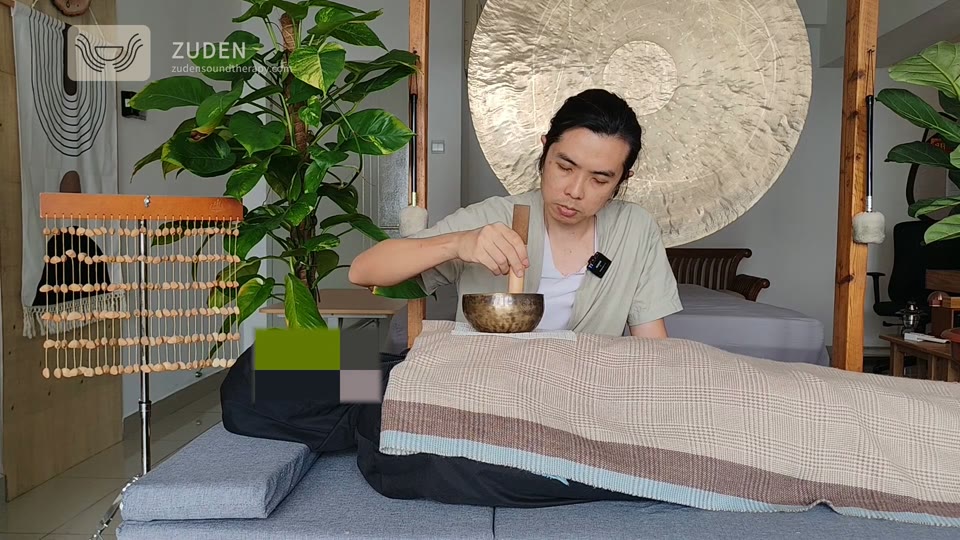
Short answer: one bowl is not more advanced than seven. It gives a beginner fewer variables, so the relationship between movement and sound becomes easier to observe.
More tools can hide the cause of a change
With several bowls, mallets, positions and sequences, the sound may change for many reasons at once. A learner hears a difference but cannot identify whether it came from force, strike point, distance or a different bowl. An occasional pleasant sound is difficult to repeat when the cause is unknown.
Using the same bowl, mallet, posture and distance creates a baseline. The next attempt can change one thing only.
Movement, principle and awareness
ZUDEN organises learning into three connected layers. Movement makes a result repeatable. Principle helps the learner troubleshoot. Awareness brings the decision back to the person, room and real response. Memorised steps alone are not enough when conditions change; theory alone does not create stable hands; intuition without boundaries can turn a temporary feeling into an unsupported conclusion.
Try a three-strike repeatability test
- Place one small bowl on a stable soft pad and use the same mallet.
- Strike three times with a comfortable medium movement.
- Let each sound become clearly quieter before the next strike.
- Note which two attempts were most similar, using one observation only: volume, tail or hand feel.
- In the next round, change only force, strike point or distance.
The purpose is not perfection. It is a feedback loop: act, listen, record and adjust.
What can one bowl teach?
A learner can practise consistent strikes, three movement levels, distance, a three-position exercise, rubbing, complete-tail listening and a short practice log. These skills remain useful when later working with four bowls, seven bowls or larger bowls.
What can it not replace?
One bowl cannot reproduce multi-bowl intervals, spatial layers or group applications. Playing for another person also requires consent, safe volume, distance, body boundaries, observation and the willingness to pause. Fewer instruments do not mean less responsibility.
Safety and boundaries
Keep the bowl and mallet stable and never strike suddenly near an ear. Reduce volume, increase distance or stop when discomfort, ringing, dizziness or marked tension appears. Practice is not an endurance test and does not diagnose physical or emotional conditions.
Frequently asked questions
Can one bowl replace a seven-bowl course?
No. It builds repeatable foundations; multi-bowl work adds intervals, combinations and spatial applications.
How long should I practise?
When time is short, three minutes of strike, listen and note can still be useful.
Does feeling nothing mean the bowl is unsuitable?
No. A neutral response is also a normal result and can be recorded without forcing an interpretation.
Must I buy a bowl before learning?
Online practice requires a suitable small bowl. Practice bowls are provided in the Kuala Lumpur class.